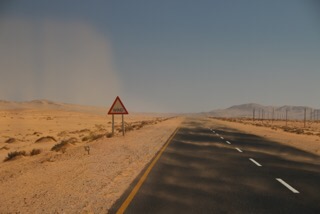
My childhood memories of Luderitz are of gale force winds and a camping site on a rocky outcrop overlooking the sea. On arrival to this tumbleweed town, on a sleepy Saturday afternoon I can remember my parents taking one look at the campsite after almost losing the car door when they jumped out to inspect, only to get back into the car and declare ‘forget it!’ So we promptly turned back towards the east and navigated this rather dull road back into the heart of Namibia.
I had relayed this story to Kevin several times and had also insisted on a B&B. Considering we had already taken a hammering while in Port Nolloth I didn’t fancy the tent sustaining any more damage.
Luderitz lived up to our expectations and once again on arrival the wind was blowing a hoolie, though as it wasn’t a Saturday (no idea what day it was as they are starting to merge into one) there was a number of people around. We headed for the oyster factory – one of the draws apart from Kolmanskop to the area. Sadly the factory had closed down and no one in town seemed to be serving the slippery little guys either even though Namibian oysters are rumoured to the some of the best in the world.
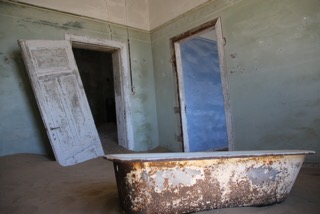
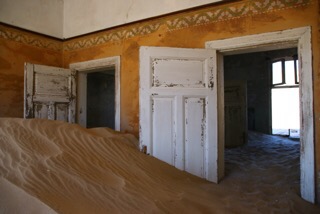
The highlight for this area really was Kolmanskop which we visited the following morning. This is a ghost town, once a thriving diamond mining area with the last people having left in the 1950’s and slowly the town is being reclaimed by the elements, mostly sand. There are some buildings that have been restored to give visitors an idea of what it was like. This is a place employing about 300 people who were being paid 900 carats of diamonds for one days work (about the equivalent of £120k/day), though few left wealthy as they then proceeded to spend all their diamonds on living costs, entertainment and drinking. Diamonds were in such abundance at this stage that there are pictures of people crawling on the ground picking them up from the sand, hard to believe really but true. The minerals were soon exhausted and with other areas further south showing better prospects people started to leave. Clearly it was a hard life in the desert though made more bearable by the bowling alley, swimming pool and the constant string of entertainers that were brought from Europe. In addition to this a lot was shipped in as Kolmanskop is about 10km from the coast and the germans wanted their home comforts.
After a morning wondering through the deserted buildings, climbing through windows and crouching through doorways as the sand was so high we too headed back towards the east. This time though we turned off towards the Namib-Naukluft National Park, though first we headed for the Tiras mountains.

 misteroverland